
 Español
 Portugues
 Pусский
 Français
 العربية
 ไทย
ไทย Türk dili
 Indonesia
 Tiếng Việt


Power Station Conductor
A power station conductor is a crucial component in the transmission of electrical energy from the generating units to the external grid and auxiliary systems. Its primary function is to carry large currents safely and efficiently at high voltages while minimizing power losses, mechanical failures, and safety hazards. Because the environments in and around power stations are demanding, conductors must be designed with careful attention to electrical, thermal, and mechanical requirements.Material selection is one of the most important aspects of power station conductor design. Aluminum and copper are the most common conductive metals due to their high electrical conductivity and mechanical reliability. Aluminum is favored in many high‑voltage applications because it offers a good balance of conductivity, low weight, and cost. In situations where space is limited or very high current densities are required, copper may be chosen for its superior conductivity and mechanical strength. In some designs, composite or reinforced conductors are used to provide additional tensile strength, especially in overhead lines subjected to wind, ice, and thermal expansion.A power station conductor must withstand a combination of electrical, thermal, and mechanical stresses. During operation, large currents generate heat through resistive losses. The conductor must therefore be sized and installed so that its temperature remains within safe limits, preventing damage to insulation, support structures, and surrounding equipment. Adequate cross‑sectional area, appropriate material, and proper ventilation or cooling are all considered to keep temperatures under control. The design also accounts for potential overloads and fault conditions, such as short circuits, where current levels can rise sharply for brief periods.Mechanical integrity is equally important. Conductors in a power station may be installed as rigid busbars, flexible cables, or overhead lines. Busbars are often used in indoor switchgear and generator connections where compact, rigid structures are needed. They are typically made of copper or aluminum bars, shaped for optimal current distribution and mechanical support. Flexible cables are used where movement, vibration, or complex routing is expected. Overhead conductors, used for outgoing transmission lines, must resist mechanical stresses from wind, temperature changes, and environmental exposure.Electrical performance goes beyond simple current‑carrying capacity. The conductor must be compatible with the system’s voltage level, insulation coordination, and clearances. Proper spacing between phases and from grounded structures is necessary to prevent flashover and partial discharges. Surface condition and geometry are also important, as they influence corona discharge at high voltages, which can cause energy loss, noise, and interference. In some cases, bundled conductors are used on high‑voltage lines to reduce corona effects and increase current capacity.Reliability and safety are central design goals. Conductors must comply with relevant standards for temperature rise, short‑circuit withstand capability, fire performance, and mechanical strength. Regular inspection and maintenance help detect issues such as corrosion, loosening of joints, or insulation damage. Jointing methods, including bolted connections, compression fittings, and welded joints, are designed to provide low resistance and long‑term stability.In summary, a power station conductor is an engineered element that combines high electrical performance with robust mechanical construction. Its design and installation directly influence the efficiency, reliability, and safety of the entire power generation and transmission system.
Products
Category:
-
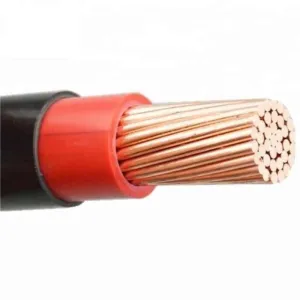
4*16 4*25 Cu/XLPE/PVC/Swa/PVC Steel Wire Armored Underground Power Cable Copper Conductor for Power Station Use
Category: Low voltage cableBrowse number: 389Number:Release time: 2025-07-03 06:23:384×16 mm² & 4×25 mm² Cu/XLPE/PVC/SWA/PVC steel wire armored underground power cable designed for power station applications. The cable features a copper (Cu) conductor, cross-linked polyethylene (XLPE) insulation, polyvinyl chloride (PVC) bedding, steel wire armor (SWA) for mechanical protection, and an outer PVC sheath for durability and environmental resistance. Its robust construction ensures reliable power transmission in underground installations, offering high electrical performance, mechanical strength, and resistance to moisture, chemicals, and physical stress. The cable complies with international standards for power distribution in demanding environments, making it suitable for power stations and other critical infrastructure applications. -
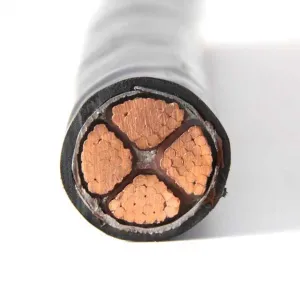
RV-K Cable 1*70 1*95 1*120 1*150 Copper Conductor with PVC Insulation for Power Station Applications
Category: Low voltage cableBrowse number: 317Number:Release time: 2025-08-01 08:13:32The RV-K Cable series (170, 195, 1120, 1150) is a single-core copper conductor cable developed for the special working conditions of power stations. With PVC as the insulating material, it integrates stability, adaptability and safety, becoming a core component of the power transmission system in power stations. The conductor is made of high-conductivity copper with a purity of 99.9%, processed through precision wire drawing and annealing processes. It not only has low conduction loss but also excellent mechanical strength, able to withstand current impact under long-term high-load operation in power stations. The four cross-sectional area specifications in the series—70mm², 95mm², 120mm², and 150mm²—form a complete gradient: 70mm² is suitable for power supply of small and medium-sized auxiliary equipment such as water pumps and fans; 95mm² can meet the needs of low-voltage side outgoing lines of transformers; 120mm² and 150mm² are adapted to medium and high-load core equipment such as steam turbines and generator sets, realizing full-scenario power coverage. The PVC insulation layer has been improved with a special formula, extending the temperature resistance range to -15℃ to 70℃, and can maintain stable insulation performance in high-temperature machine rooms in summer or open-air areas in winter of power stations. Its dense molecular structure can effectively block water vapor, dust and slight chemical corrosion, avoiding insulation aging caused by environmental factors. At the same time, PVC material has self-extinguishing properties, which can quickly flame retardant when exposed to open fire, delaying the spread of fire and gaining time for fire emergency in power stations. The single-core design is a major advantage of this series: the non-stranded structure reduces internal stress when the cable is bent. When laying in narrow spaces such as cable trenches and equipment mezzanines in power stations, it can easily bypass obstacles such as pipes and brackets, reducing installation difficulty. In addition, the outer sheath of the cable is made of wear-resistant PVC material, with outstanding anti-extrusion performance, which can resist mechanical collisions during daily maintenance and prolong service life. From the precision control circuit of the fuel pump room to the power transmission main line of the main factory building, the RV-K Cable series, with its diversified specifications and scene adaptability, perfectly connects all levels of the power supply system in the power station. It not only ensures the continuous operation of key equipment but also provides convenient wiring and maintenance conditions for operation and maintenance personnel, making it a preferred solution that balances technical performance and practical value. -
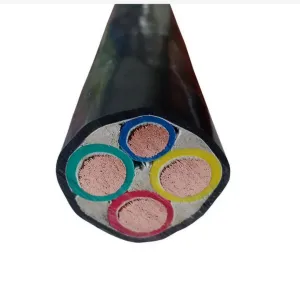
U1000 R2V Cable 1*240mm2 1*300mm2 1*400mm2 1*500mm2 Copper Conductor XLPE Insulation for Power Station Application
Category: Low voltage cableBrowse number: 450Number:Release time: 2025-08-05 06:36:08U1000 R2V cable is a high-voltage power transmission cable specially designed for power station scenarios, covering various cross-sectional area specifications such as 1240mm², 1300mm², 1400mm², and 1500mm². With copper conductor as the core and cross-linked polyethylene (XLPE) as the insulation layer, it has become a key component in the power transmission system inside and around the power station due to its excellent electrical performance and structural stability. In terms of specification parameters, the rated voltage of this series of cables is 1000V, which is suitable for the voltage requirements of the low-voltage distribution network in the power station. Different cross-sectional areas correspond to different current-carrying capacities: the 1240mm² cable has a current-carrying capacity of about 420A when laid in the air and about 350A when laid underground; the 1300mm² cable has a current-carrying capacity of 480A in the air and about 400A underground; the 1400mm² cable has a current-carrying capacity of 550A in the air and 460A underground; the 1500mm² cable has a current-carrying capacity of 630A in the air and 530A underground. This gradient specification design can meet the transmission needs of different power levels in the power station, from the power supply of auxiliary equipment to the outlet of the main transformer, and flexibly adapt to the power connection of equipment such as boilers, steam turbines, and generator sets. In terms of materials, the conductor is made of high-purity electrolytic copper (purity ≥99.95%), formed by bunch stranding process, which not only ensures excellent conductivity (conductor DC resistance ≤0.0741Ω/km at 20℃) but also enhances the resistance to mechanical vibration, which can cope with the high-frequency vibration environment during the operation of power station equipment. The insulation layer is made of XLPE material, which forms a three-dimensional network molecular structure through peroxide cross-linking process. It has a temperature resistance range of -40℃ to 90℃, can withstand high temperatures of 130℃ during short-term overload, and has an insulation resistance of ≥1000MΩ·km and a dielectric loss tangent value of ≤0.003 (at 20℃), effectively reducing energy loss during power transmission and ensuring insulation stability under high voltage. In addition, the outer sheath of the cable is mostly made of weather-resistant polyvinyl chloride (PVC) or halogen-free low-smoke flame-retardant materials, which have UV resistance, chemical corrosion resistance, and flame-retardant properties, adapting to the complex outdoor and indoor environments of the power station. The characteristic applications focus on the full-scene power transmission of the power station: in the power generation plant, the 1500mm² cable can be used as the connecting cable from the main transformer to the high-voltage switchgear, undertaking large-capacity power output; the 1400mm² cable is suitable for the transmission line between the generator set and the step-up station; the 1300mm² cable is often used for the power cables of large auxiliary machines such as boilers and water pumps; the 1240mm² cable is adapted to low-voltage auxiliary circuits such as lighting and control systems. In the outdoor distribution area of the power station, this series of cables can be laid underground or through pipes, resisting soil corrosion and temperature difference changes, ensuring stable power distribution from the step-up station to each node in the plant area. At the same time, its single-core structure is convenient for laying in narrow spaces, suitable for the dense cable trenches and bridge layouts of the power station. In terms of structural design, the cable adopts a composite structure of "conductor-insulation layer-shielding layer-sheath layer". The shielding layer is made of semi-conductive material, which can evenly distribute the electric field and avoid insulation breakdown caused by excessive local electric field strength; the thickness of the sheath layer is 2.0-3.0mm according to different specifications, providing mechanical protection and environmental isolation. In addition, the bending radius of the cable is not less than 12 times the outer diameter, meeting the bending requirements in complex wiring of the power station, and it has passed multiple national standards such as GB/T 12706, ensuring safety and reliability under long-term high-load operation. In general, the U1000 R2V series cables, with multi-specification adaptability, high conductivity efficiency, and strong environmental adaptability, have become the core transmission carriers of the power station's power system, providing a solid power guarantee for the stable operation of the power station.
News
Category:
No search results found!
Case
Category:
No search results found!
Video
Category:
No search results found!
Download
Category:
No search results found!
Job
Category:
No search results found!
Featured Products
No search results found!



 Phone
Phone E-mail