
 Español
 Portugues
 Pусский
 Français
 العربية
 ไทย
ไทย Türk dili
 Indonesia
 Tiếng Việt


Aluminum Underground Cable
Aluminum underground cable is a widely used power cable designed for permanent installation below ground level. It is typically chosen for distributing electricity in residential areas, commercial developments, industrial facilities, and utility networks. The cable combines the advantages of aluminum conductors with robust insulation and protective layers, making it suitable for harsh underground environments.The core of the cable is made from aluminum, either as solid conductors or stranded wires twisted together. Aluminum is significantly lighter than copper, which simplifies handling, transportation, and installation, especially over long distances or in large cross-sections. Although aluminum has a lower electrical conductivity than copper, this is compensated by using a slightly larger conductor size to achieve similar current‑carrying capacity. The lower material cost of aluminum often results in substantial savings for large projects.Around the aluminum conductors, several layers are applied to ensure safe and reliable operation. First, each conductor is insulated with a dielectric material such as cross‑linked polyethylene (XLPE) or PVC. XLPE is commonly preferred for medium‑voltage and high‑voltage underground cables because it offers excellent thermal stability, electrical performance, and resistance to aging. PVC insulation is more common in low‑voltage applications where mechanical and chemical requirements are less demanding.In multi‑core designs, multiple insulated conductors are laid up together, often with fillers to maintain a round shape, and then wrapped with bedding or inner sheath material. An important component of aluminum underground cable is the metallic screen or armor, which may consist of steel wire armor (SWA), steel tape, or sometimes aluminum armor. This layer provides mechanical protection against impact, crushing, or accidental excavation damage. It also helps control electromagnetic fields and can serve as a fault return path or grounding conductor when properly designed.Over the armor, an outer sheath is applied, typically made from PVC, polyethylene (PE), or low smoke zero halogen (LSZH) material. The sheath protects the cable from moisture, chemicals in the soil, and environmental influences. PE sheathing offers good resistance to water and many chemicals, while LSZH versions are used in locations where fire safety and low toxic emissions are critical, even though the cable is underground and may emerge in buildings or cable vaults.Installation of aluminum underground cable requires proper trench design, bedding materials like sand or fine soil, and sometimes protective conduits or tiles. Adequate depth and spacing from other utilities are essential to meet safety codes. Correct jointing and termination practices are also crucial, particularly for aluminum conductors, which need compatible connectors, appropriate surface preparation, and controlled tightening torque to avoid excessive contact resistance and overheating.Aluminum underground cable is used for feeder circuits in distribution networks, direct connections from substations to buildings, street lighting systems, and renewable energy plants such as solar farms and wind parks. Its balance of cost, weight, and performance makes it a practical choice for both new installations and network upgrades. When properly designed, installed, and maintained, aluminum underground cable provides long‑term, reliable power delivery under a wide range of electrical and environmental conditions.
Products
Category:
-
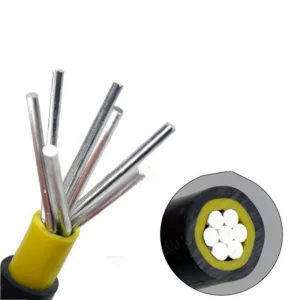
Nayy Nayy-J Nayy-O Al PVC PVC 0.6/1kv Aluminum Underground Power Cable
Category: Low voltage cableBrowse number: 446Number:Release time: 2025-07-03 07:57:31Nayy-J/Nayy-O 0.6/1kV Aluminum PVC Underground Power Cable is designed for underground power distribution, featuring aluminum conductors (stranded for Nayy-J, solid for Nayy-O) with PVC insulation/jacket. Rated at 0.6/1kV, it offers reliable electrical performance, mechanical durability, and environmental resistance, suitable for building, industrial, and municipal power networks. Key Features: Conductor: High-purity aluminum (AA-1350 or equivalent), compliant with IEC 60228 Insulation: PVC, 70℃ temperature rating, chemical-resistant Sheath: Black PVC, abrasion/waterproof, for direct burial or duct installation Voltage Rating: U₀/U=0.6/1kV Applications: LV power distribution, cable trenches, tunnels, and fixed indoor wiring -
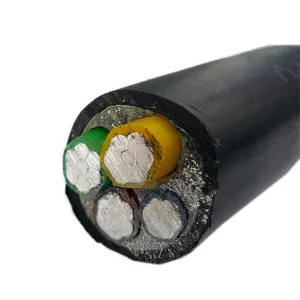
Nayy-J Se 0.6/1 Kv Aluminum Underground Cable for Solar Farms 4X95 4X150 4X240 mm2 Alu Electric Cable Core Power Cables
Category: Low voltage cableBrowse number: 509Number:Release time: 2025-08-07 07:17:08Nayy-J Se 0.6/1 Kv aluminum underground cable is a core power transmission cable specially designed for solar farms. Its three specifications of 4X95 mm², 4X150 mm², and 4X240 mm² can meet the power collection and transmission needs of photovoltaic power stations of different scales. The cable adopts aluminum conductors and special insulation and sheath structures, featuring resistance to underground environmental erosion, mechanical damage, and low loss, making it an ideal choice for underground wiring in solar power generation systems. The conductor is made of high-purity aluminum material with a purity of ≥99.6%, manufactured through multi-strand stranding process, which balances conductivity and flexibility. The DC resistance of the single-core conductor of 4X95 mm² cable at 20℃ is ≤0.193Ω/km, 4X150 mm² is ≤0.124Ω/km, and 4X240 mm² is ≤0.0779Ω/km, all lower than industry standards, which can effectively reduce energy loss during power transmission. The weight of aluminum conductors is only 1/3 of that of copper conductors of the same specification, greatly reducing the construction load during underground laying, especially suitable for long-distance wiring in large-area photovoltaic arrays. The insulation layer is made of weather-resistant XLPE (cross-linked polyethylene) material, which, after optimization with a special formula, has a temperature resistance level of 90℃. It can operate stably for a long time under the rated voltage of 0.6/1 Kv, and withstands a high temperature of 250℃ during short circuits (within 5 seconds). The insulation resistance is ≥10¹⁴Ω·m, and the dielectric loss tangent is ≤0.002 (at 90℃), which can effectively isolate the risk of electric leakage and ensure the safety of low-voltage DC/AC transmission in photovoltaic systems. In addition, the insulation layer has passed the GB/T 18380.1-2008 flame retardancy test, which can inhibit flame spread and reduce smoke release in case of accidental fire. The sheath and armoring design of the cable is optimized for the underground environment: the inner sheath is made of oil-resistant PVC material with a tensile strength of ≥12MPa and an elongation at break of ≥150%, which can resist moisture and chemical erosion in the soil; the outer armoring is a double steel tape lapped structure, and the armoring thickness increases with specifications (0.3mm for 95 mm² and 0.5mm for 240 mm²), which can withstand extrusion, dragging during underground construction and soil pressure, protecting the internal structure from mechanical damage. The overall structure also includes a semi-conductive shielding layer, which can evenly distribute the electric field and avoid insulation aging caused by partial discharge. The current-carrying capacity performance is adapted to the characteristics of solar power generation: the 4X95 mm² cable has a current-carrying capacity of about 210A when laid in soil, suitable for connecting the combiner box to the inverter in small photovoltaic arrays; the 4X150 mm² has a current-carrying capacity of about 280A, which can meet the needs of low-voltage DC confluence lines in medium-sized power stations; the 4X240 mm² has a current-carrying capacity of 380A, suitable for high-voltage side grid-connected lines in large-scale power stations. Its minimum bending radius is 10 times the cable outer diameter (static). The outer diameter of 4X95 mm² cable is about 55mm, and the static bending radius is 550mm, which is convenient for bending and laying in the narrow space under the photovoltaic panel. In the specific application of solar farms, the cable is mainly used for underground connection between photovoltaic module strings and combiner boxes, low-voltage DC transmission from combiner boxes to inverters, and low-voltage AC lines from inverters to booster stations. Its underground laying method can avoid direct sunlight, wind and rain erosion, and man-made damage, extending the service life to more than 30 years, which is highly matched with the operation cycle of solar power stations. At the same time, the cost-effective characteristics of aluminum conductors can reduce the initial investment cost of large-scale photovoltaic projects, and the procurement cost per kilometer of cable is 40%-50% lower than that of copper cables. Overall, through material optimization and structural innovation, Nayy-J Se 0.6/1 Kv aluminum underground cable achieves a balance between conductivity, environmental adaptability, and economy, providing a safe, reliable, and cost-controllable power transmission solution for solar farms.
News
Category:
No search results found!
Case
Category:
No search results found!
Video
Category:
No search results found!
Download
Category:
No search results found!
Job
Category:
No search results found!
Featured Products
No search results found!



 Phone
Phone E-mail